
When EQ Makes Accountability Harder
EQ can make you more thoughtful and more hesitant, because you are managing perception risk, not just the message. This post gives a steady fix: Perception Risk Reset plus Observation → Impact → Expectation, with an optional EQ line and one curiosity question.
You’ve rewritten the same Slack message six times.
First version is clear: “I need the report by Friday. It missed the last two deadlines." Second version is softer: “Hey! Quick check-in on the report timeline 🙂.” Third version adds context: “I know things have been busy, and I really appreciate your effort...”
By version six, the point has disappeared. You close your laptop, tell yourself you’ll address it in the 1:1, and then spend the 1:1 talking about priorities and “aligning.” It’s not the feedback that feels hard. It’s what it might cost you.
The pattern: EQ made you more thoughtful…and more hesitant
A lot of managers become more empathetic over time. They care about impact. They don’t want to bulldoze people.
And then something subtle happens: your ability to consider other people’s experience gets stronger… while your willingness to be direct gets weaker.
The inner loop often sounds like this:
- If I’m direct, I’ll damage trust.
- If I soften it, nothing changes.
- If I wait, it gets worse.
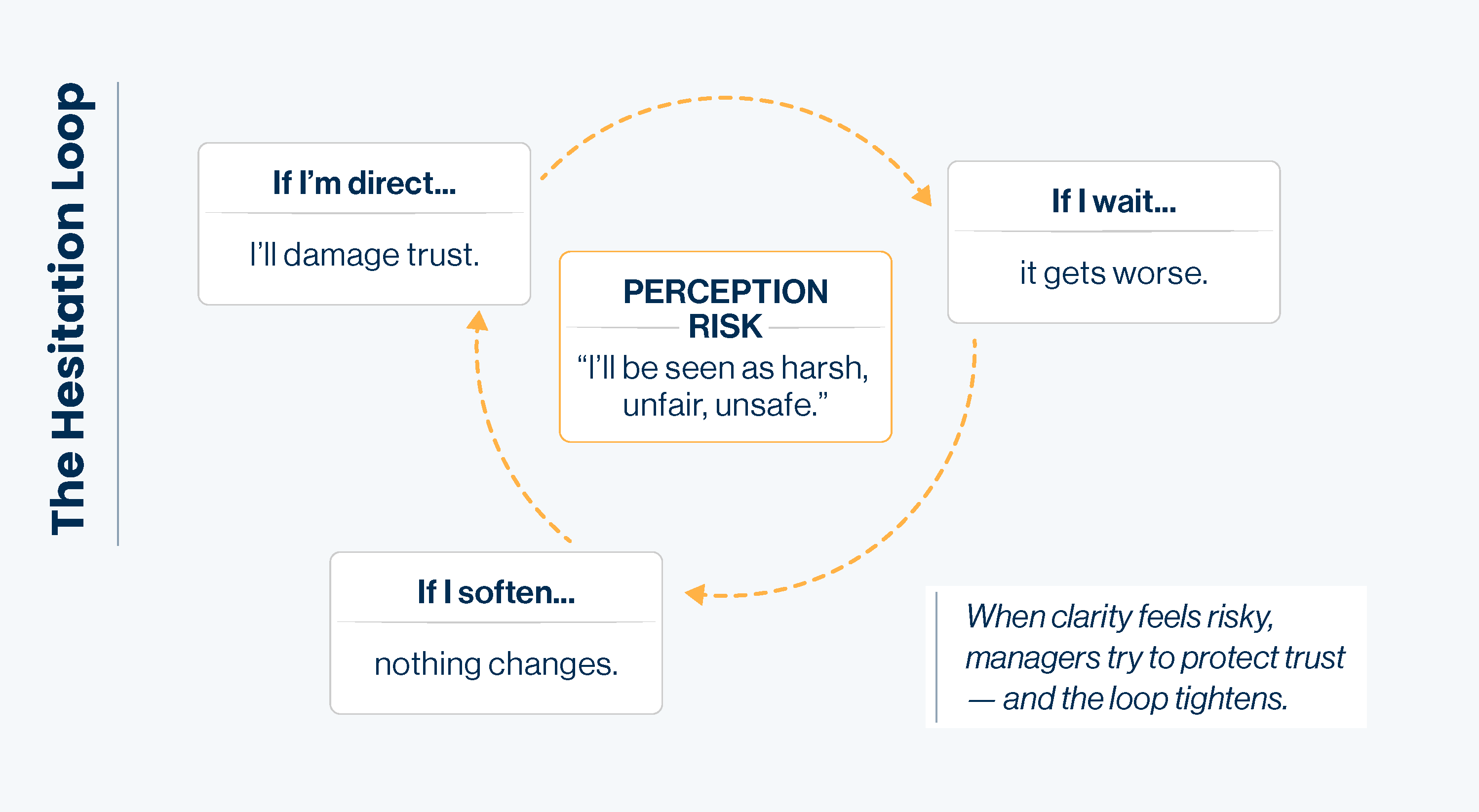
You end up caught between two values: being humane and being responsible. Here’s the core insight: many managers aren’t avoiding accountability because they don’t care.
They’re avoiding identity risk: "If I’m clear, I’ll be seen as harsh, unfair, or unsafe."
That’s a very different problem than “you need to improve your communication skills.”
What’s actually happening: perception risk
When you’re trying to hold someone accountable, you’re not just managing their reaction. You’re managing how their reaction might rebound onto you. It’s a perceptual risk. And even if you don’t call it that, you’re already managing it:
- Fear of being labeled harsh or unfair.
You pause because you don’t want to be “that manager.” Especially if your org values kindness or inclusivity. - Fear of being seen as incompetent or weak.
You hesitate because if you didn’t set things up right, do you really have the standing to push for change? - Fear of losing relationship currency.
You’ve built trust with someone. You don’t want to spend it on a hard conversation. Especially not with top performers, peers, or people who carry influence.
This is where the “nice manager” identity shows up. Many managers have learned, explicitly or implicitly, that being agreeable is safer than being clear. You hedge. You delay. You pad.
Not because you’re conflict-avoidant. Because you’re trying to stay kind and stay respected. You’re trying to stay trusted.
The common mistakes (and why they backfire)
Most advice about accountability focuses on what to say. But when the real issue is perception risk, the "fixes" often become new forms of avoidance.
Here are four patterns that show up in well-intentioned managers:
-
“I’ll just be softer.”
You turn a standard into a suggestion. The message disappears. You feel like you said it; they feel like it was optional. -
“I’ll wait until it’s urgent.”
You delay because you want more data, better timing, a calmer day.
Now the issue is loaded. One clean correction turns into a bigger conversation with more frustration baked in. -
“I’ll hint.”
You drop vague signals: “Let’s keep an eye on timelines.”
They’re confused. You’re frustrated. They don’t know what needs to change, or why it matters. -
“I’ll over-explain so they don’t misread me.”
You pad with disclaimers: "I know it's been a tough season... I just wanted to check in... this isn't a big deal but..." Now the listener has to search for the point. The clarity gets buried under your discomfort.
These aren’t communication problems. They’re discomfort management strategies.
The real issue: clarity is not cruelty
If you value empathy, it’s easy to treat clarity like a threat. But clarity isn’t the opposite of empathy. It’s one of its forms.
Clarity is respect. It tells someone the truth they need in order to succeed.
Accountability is care for the person and the team.
When standards aren’t named, your strongest people end up compensating. Timelines slip quietly. Resentment grows in places you don’t see until it’s bigger.
The goal isn’t harshness. The goal is truth with dignity.
When you avoid being clear, you don’t avoid harm. You just delay it, and distribute it to more people.
A practical anchor: Observation → Impact → Expectation
You don’t need a full script or a new personality. You need a simple structure that helps you stay steady when perception risk spikes.
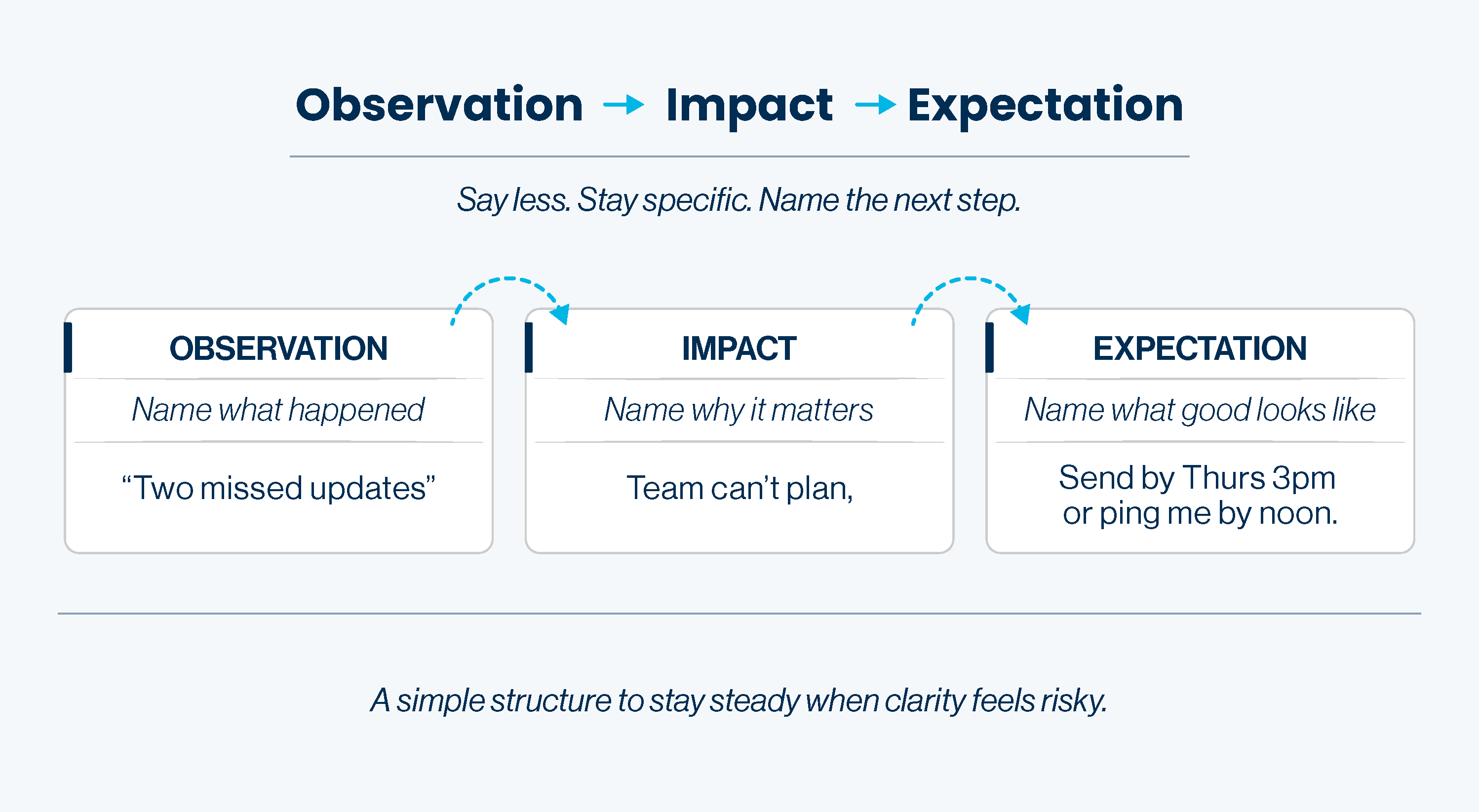
Try this three-part anchor:
- Observation: What happened (concrete and specific)
- Impact: Why it matters (to team, trust, timing, etc.)
- Expectation: What "good" looks like going forward (what, by when)
Micro-example 1: Missed deadline with a top performer
You’re hesitant because they’re talented, busy, and you don’t want to look like you’re nitpicking.
- Observation: “The last two project updates were shared after the agreed deadline.”
- Impact: “It puts the team in a reactive position and makes it harder for me to plan dependencies.”
- Expectation: “Going forward, I need the update by 3pm Thursday. If something changes, message me by noon so we can adjust.”
- EQ layer (one line): “I’m bringing this up because your work sets the pace for others—and I want you to have what you need to meet that standard.”
- One curiosity question: “What’s the most common thing that gets in the way? Time, priority shifts, or something else?”
Micro-example 2: Boundary/tone issue with a peer
- Observation: "In the meeting, you interrupted me twice while I was answering."
- Impact: "It made it harder to land the decision and undercut my ability to represent my team."
- Expectation: "In future meetings, I need space to finish my point. If you disagree, let’s address it after I’ve laid out the context."
Notice what’s not here: a lecture, a long justification, or vague reassurance. It’s direct, but it still signals respect and makes it safe to problem-solve.
A quick self-check
Before you send the message or say the sentence, ask:
Is my expectation clear enough that we could both tell, next week, whether it happened?
If the answer is no, you’re probably still hiding inside suggestion language.
Closing: permission and a next step
If you hesitate to be direct, it usually means you care.
You’re trying to protect people from unnecessary harm, and you’re trying to stay fair.
You don’t need to become sharper to be effective. You need to become clearer.
Pick one small moment this week, one message you’d normally soften and one standard you’d usually hedge. Use the three-part anchor: Observation → Impact → Expectation.
Say less than you want to say. Name the next step. Follow up once.
If you want help finding words that feel direct without being rude, use our Lead With Clarity Lab resources:
Subcribe and get access to the Feeback Clarity Builder.